
Video
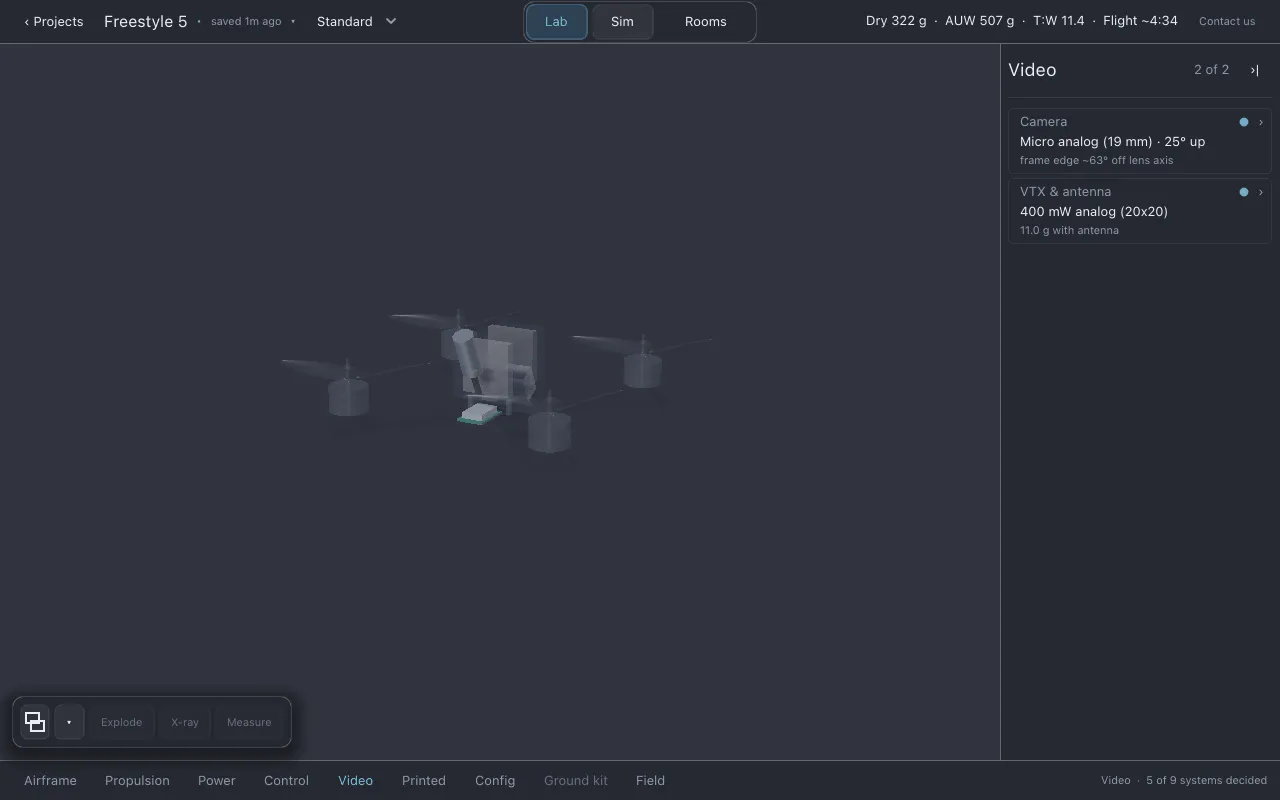
Video is what the pilot sees: the camera at the front, the angle it is tipped up at, and the video transmitter (VTX) and antenna that send the picture to the goggles.
Where it is
Section titled “Where it is”Click Video in the section row. The list shows Camera and VTX & antenna.
Both pages show the Electronics rail above their sheet. That rail is where the camera, the video transmitter and the antenna are chosen, one bay each.
Camera
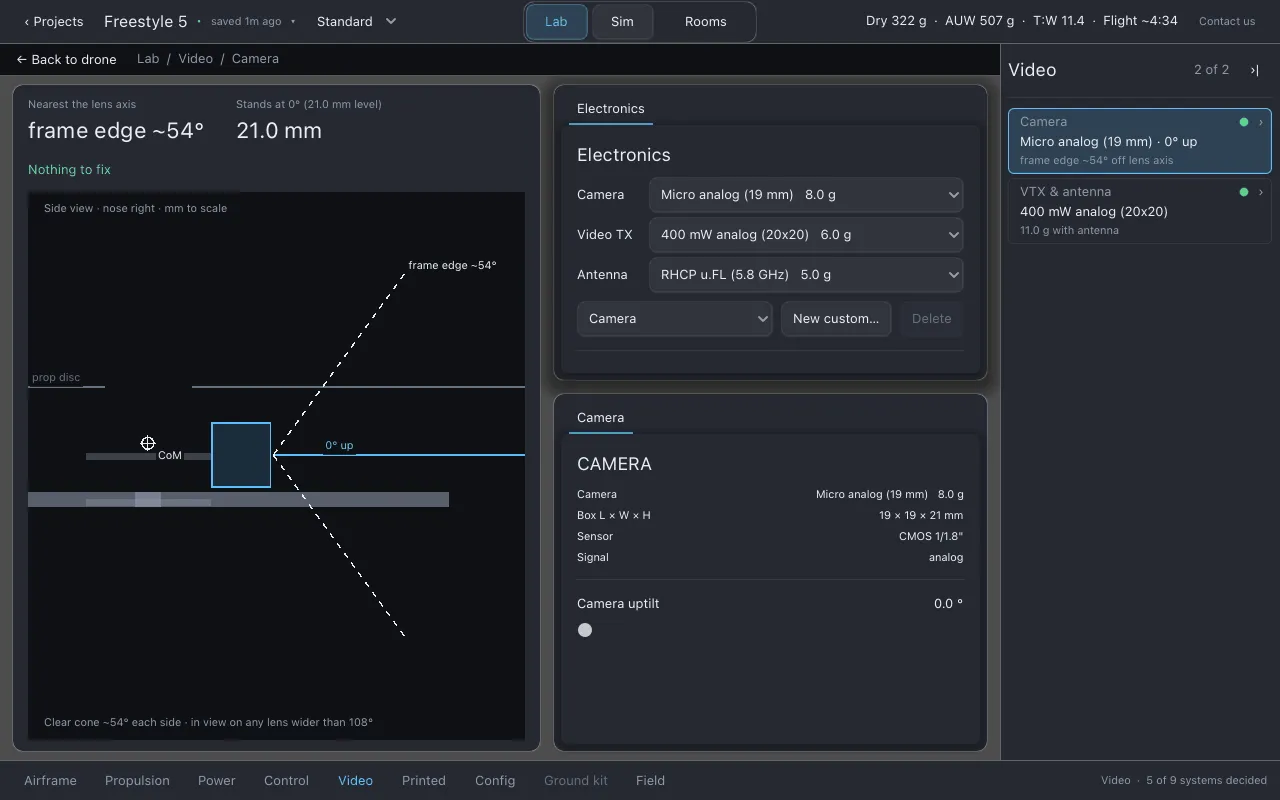
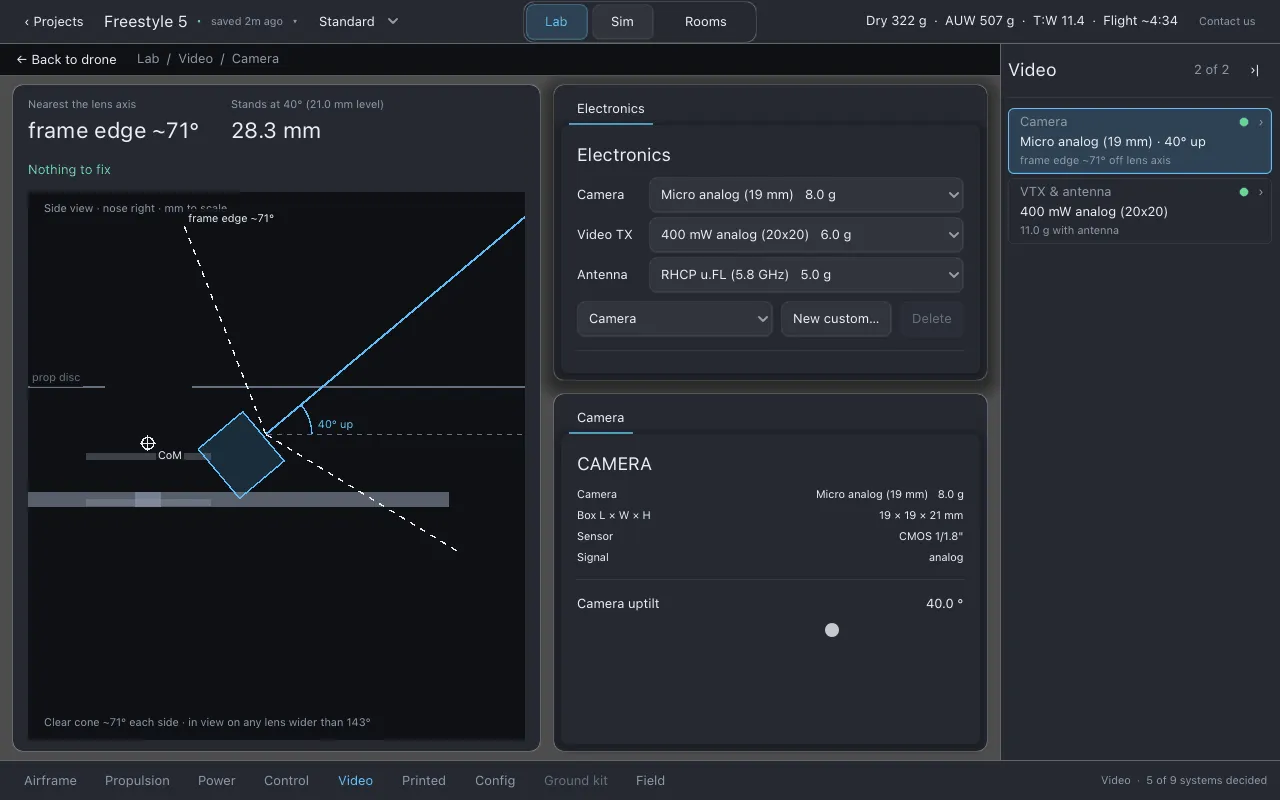
Section titled “Camera”- Line 2: the camera and its uptilt, for example
<camera name> · 25° up, ornone. - Line 3: what comes nearest the lens’s line of sight: the edge of the frame, or a part that sits closer.
- The page shows Nearest the lens axis (what, and at what angle) and how tall the camera stands at its tilt, with a side view of the camera against the frame and the propeller discs.
On the Camera sheet:
- Camera uptilt is a slider for how far the camera is tipped up from level. It opens at 25°, which is a guess at what most builds fly; your camera mount is the real answer. Reset to as-built puts it back.
- Tilt changes what the lens sees and what it can hit, not the flight numbers.
- The camera’s published figures: name, box size, sensor and signal.
The uptilt is one setting for your Lothal install, shared by every drone, like the other fit settings on Layout & fit. Changing it can change the printed camera mount of every drone; see Printed.
VTX & antenna
Section titled “VTX & antenna”- Line 2: the video transmitter fitted, or
none. - Line 3: the transmitter’s mass with its antenna, or its mass and
no antenna. - The page shows VTX + antenna (their mass together) and Antenna behind CoM (how far behind the centre of mass the antenna sits), with a drawing of where they are weighed.
- The sheet is the video payload budget: camera, video TX, antenna, and Wiring, solder, tape, the mass that is not in any one part. The Electronics total is the model’s own figure.
What to watch for
Section titled “What to watch for”- Camera: the camera tilted into the top plate, and something blocking the lens’s view.
- VTX & antenna:
VTX has no antenna.
Honest limits
Section titled “Honest limits”- No camera in the catalog publishes its lens angle, so Lothal does not claim what the camera can see. It measures angles from the lens axis instead.
- The receiver’s antenna is part of the receiver entry, not a separate part. The
antennascatalog holds video antennas only.
Related
Section titled “Related”- Printed: the camera mount and antenna mount are generated from these parts
- Control → Receiver & link
- Layout & fit
Documentation licensed underCC BY 4.0. Lothal itself is GPL-3.0-or-later.Report a problem.Roadmap.