
Benches
A bench tests one part of the build on its own, the way a builder tests parts on a workbench before flying. Nothing flies on a bench.
All benches share three rules:
- They test what you have chosen. A motor is always tested with the propeller you fitted, and an ESC with the motors you fitted, because neither means anything alone.
- They use the same physics as Sim, at about 1,000 steps a second.
- They cost charge. A bench run drains the pack at 1 : 1, exactly as a flight does. On the thrust bench and the frame bench you can hear the motors.
A bench takes over the window. Click Lab in the top bar to return to the drone.
| Bench | Door |
|---|---|
| Thrust bench | Propulsion → Motors page, Open thrust bench… |
| Pack bench | Power → Battery page, Open pack bench… |
| ESC bench | Power → ESC page, Open ESC bench… |
| Frame bench | Rooms → Frame bench |
| Blade designer | Propulsion → Propellers page, Design this blade… |
Thrust bench
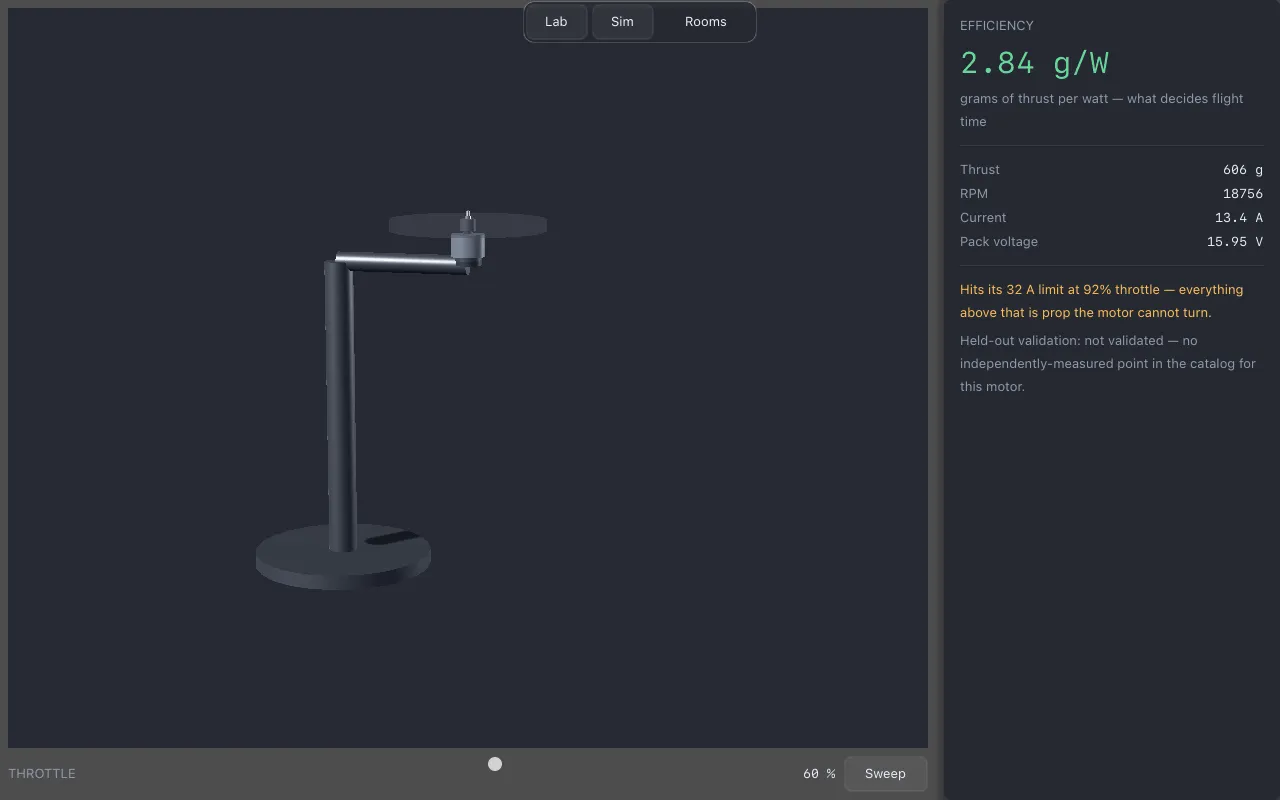
Section titled “Thrust bench”A thrust stand for your motor and propeller together.
- THROTTLE slider, or Sweep, which runs from idle to full and back.
- Readout: EFFICIENCY in grams of thrust per watt (what decides flight time), then thrust, RPM, current and pack voltage.
- It says at what throttle this pairing hits its current limit (“everything above that is prop the motor cannot turn”), or that it reaches full throttle inside the limit.
- Held-out validation: where the catalog has an independently measured point for this motor
on a different propeller, it shows how far the model’s prediction is from it. Where it does
not, it says
not validated.
Pack bench
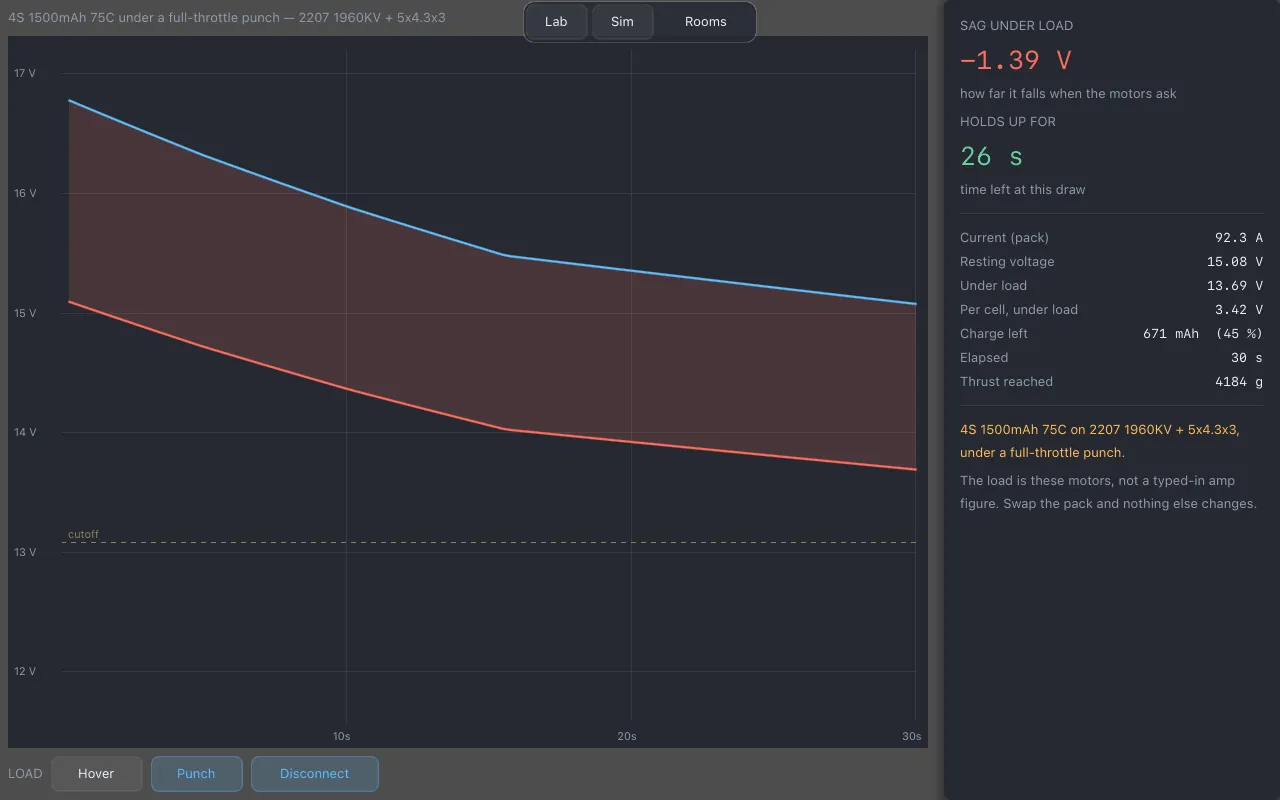
Section titled “Pack bench”A load test for your battery.
- LOAD: Hover or Punch, and Apply load / Disconnect. Switch load while it runs to watch the voltage step.
- Two headline numbers: how far the voltage sags under the load, and how long the pack holds up.
- Readout: current, resting voltage, voltage under load, voltage per cell under load, charge left, elapsed time, and thrust reached.
ESC bench
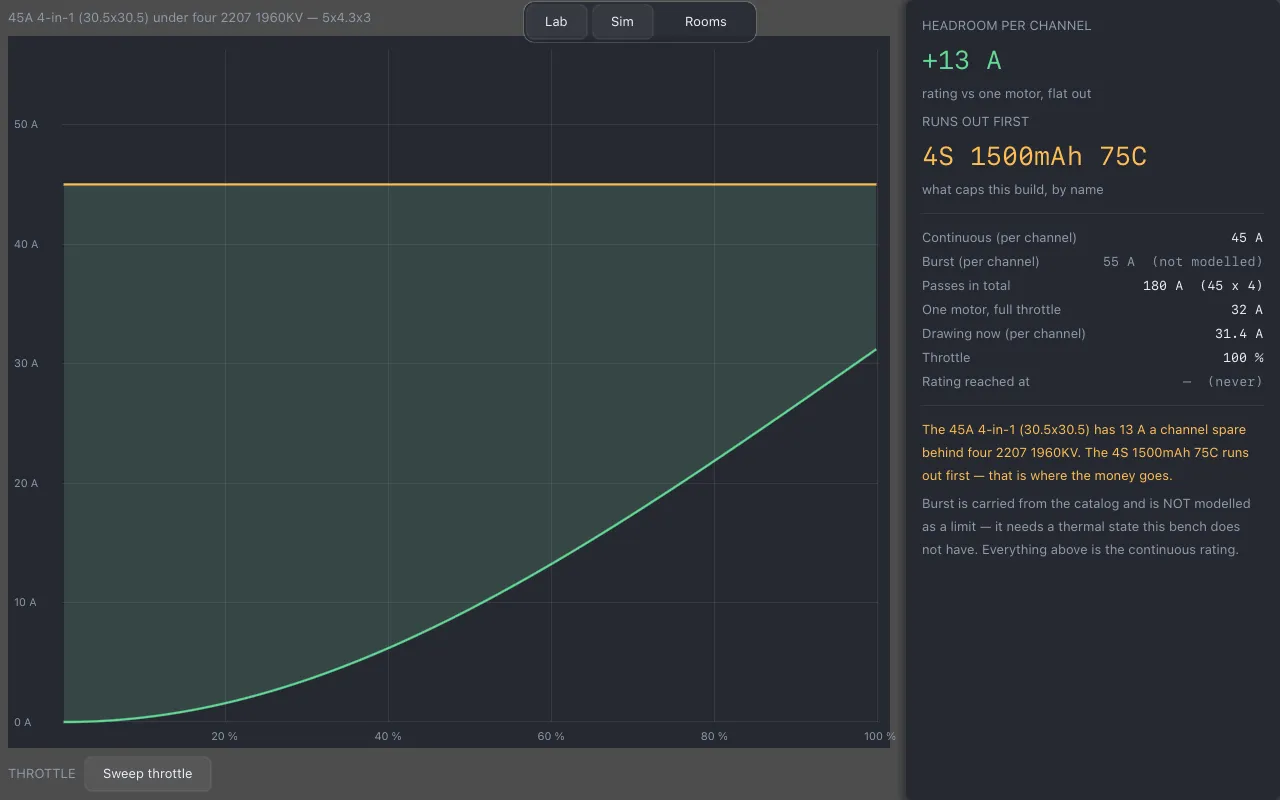
Section titled “ESC bench”Tests your ESC against the four motors you have chosen.
- Sweep throttle to see what one channel actually passes.
- Two headline numbers: current per channel against the board’s continuous rating, and, if the ESC is not what runs out first, which part is.
- Readout: continuous and burst rating per channel, what the board passes in total, one motor at full throttle, the current per channel now, the throttle, and the throttle at which the rating is reached.
What benches cannot tell you
Section titled “What benches cannot tell you”- A bench is only as good as the part’s figures. Custom parts are whatever you typed.
- The thrust bench’s figures are fitted from manufacturers’ thrust tables. The held-out check shows how well that fit predicts a point it was not made from, where such a point exists.
Related
Section titled “Related”- Frame bench
- Power for the charger
- Physics is the source of truth
Documentation licensed underCC BY 4.0. Lothal itself is GPL-3.0-or-later.Report a problem.Roadmap.