
Frame bench
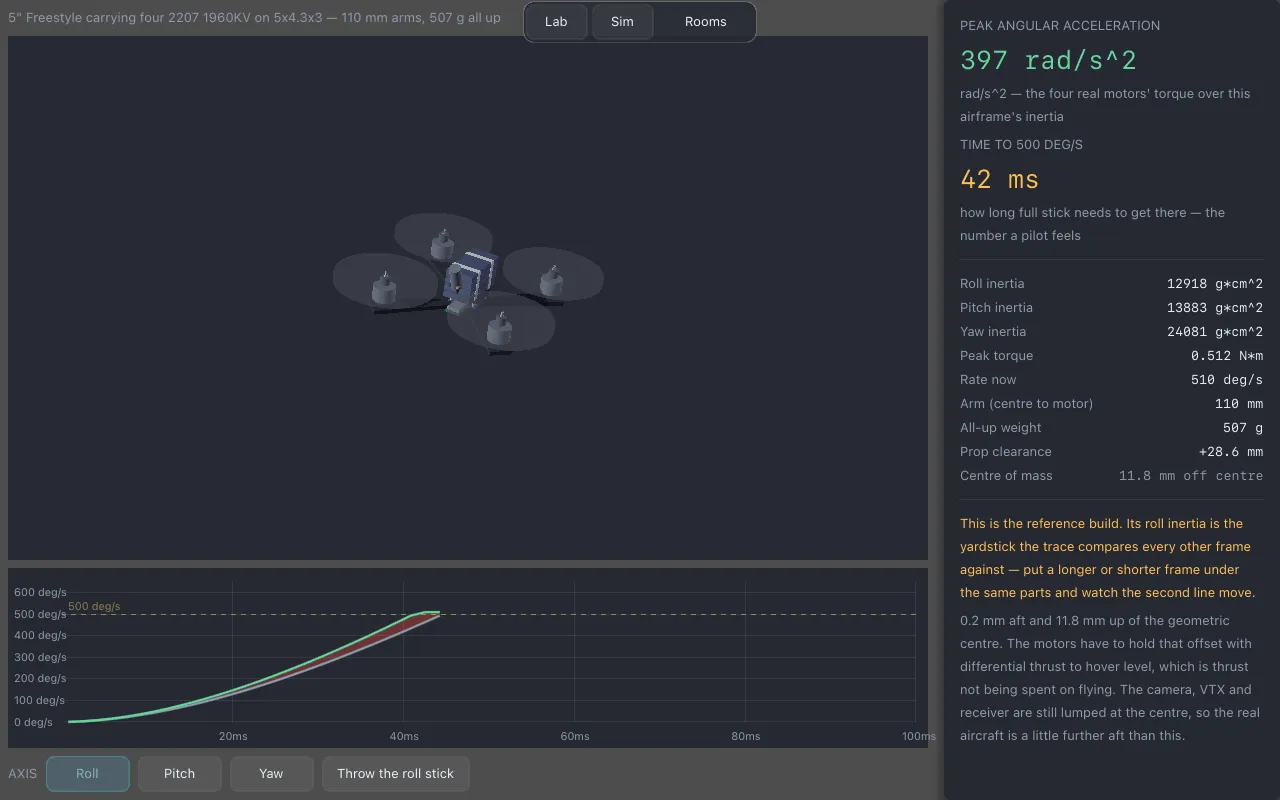
The frame bench shows what your frame does to how the drone turns. It holds the whole aircraft on one free axis, throws full stick, and times how fast it rotates, next to the 5-inch reference build doing the same thing.
Where it is
Section titled “Where it is”Click Rooms in the top bar, then Frame bench. It opens on the build you have fitted. Click Lab to go back.
What it tests
Section titled “What it tests”The frame carrying its build, never a bare frame. An empty frame has almost no inertia worth measuring. Most of a drone’s resistance to rolling comes from the motors and propellers out at the ends of the arms.
Using it
Section titled “Using it”- Choose an AXIS: Roll, Pitch or Yaw.
- Click the run button (Throw the roll stick, for example). The motors spin up, the aircraft turns, and the trace climbs.
- The run ends when the aircraft reaches the target rotation rate. Every line climbs to the same place; what differs is how long it took.
The second line on the chart is the 5-inch reference build doing the same step. The gap between the two lines is the difference your frame made. The reference uses its own pack, so it never drains yours.
The readout
Section titled “The readout”The headline is not inertia in kg·m², which is a number nobody has a feel for. It is what the inertia does: how hard the aircraft accelerates when the stick goes over, and how long it takes to reach the target rate, each against the 5-inch reference.
Below that: roll, pitch and yaw inertia, the peak torque, the current rate, the arm length (centre to motor), all-up weight, prop clearance, and the centre of mass.
What it teaches
Section titled “What it teaches”A longer arm gives the motors more leverage, so more torque. But inertia grows with the square of the arm length. So a longer-armed drone rolls slower, even though it has more leverage. Inertia wins.
Limits
Section titled “Limits”- Nothing flies on the bench. There is no gravity or translation, only rotation about one axis.
- The motors really turn, so a run costs pack charge, and you can hear them.
- Wiring is still treated as a lump at the centre.
Related
Section titled “Related”Documentation licensed underCC BY 4.0. Lothal itself is GPL-3.0-or-later.Report a problem.Roadmap.